 JawAtlas
For
For educators
Build a case once, with the structures marked and the questions written in. Then hand it to thirty devices in one gesture and open the seminar with a life-size jaw on the desk.
Author once
Import an anonymised scan, or start from the demo case. Slice to each structure, mark it, caption it and save the moment. Write the learning objectives into the case notes. Trace the arch so the panoramic is ready. How moments work.
Distribute in one gesture
Share the case from the share button. AirDrop reaches a room full of devices in a minute; a course folder works for remote groups. Students open the file in JawAtlas and get your marks, captions, notes and arch exactly as you left them. A folder of cases imports as a batch. Sharing and export.
Teach in the room
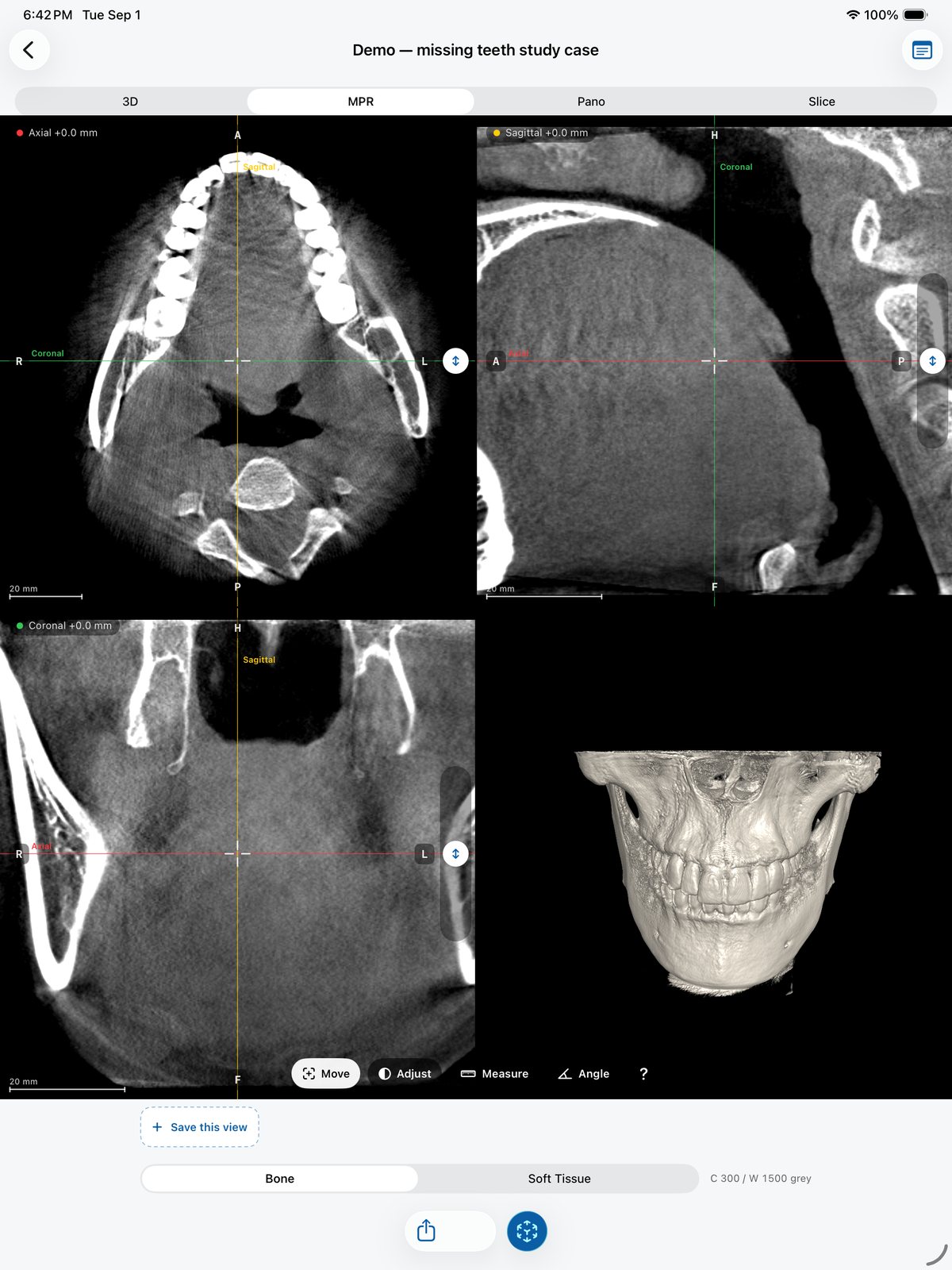
Mirror an iPad to the display for the 2 by 2 MPR grid, or anchor the scan on the desk in AR and move the device through it while the class watches the cross-section follow. Then let students do the same on their own phones.
Honest by default
Grey values are labelled as grey values, orientation labels come from the scan itself, and there is no implant or treatment tooling to distract from anatomy. The app's limits are part of the lesson. Privacy design keeps your students clear of patient data.
Data you can use
Prefer openly licensed scans. Free CBCT datasets lists verified sources with their licenses, and the DICOM guide explains what to export.
Questions students ask
Do students need accounts or a license?
No. Every student installs the free app and opens the case you share. There is nothing to administer.
Can I use our own anonymised scans?
Yes, if your institution permits it. Import a DICOM folder, and the app strips identifying tags at import. Openly licensed datasets are the safer default; see the free CBCT datasets page.
How do I show it in a lecture?
Mirror an iPad to the room display with AirPlay or a cable. The 2 by 2 MPR grid, the panoramic and the AR view all project well.
JawAtlas is an education and training aid. It is not a medical device and must not be used for diagnosis, treatment planning or any clinical decision.
Last reviewed 2026-10-13