 JawAtlas
Reference
Free CBCT datasets for learning
A verified list of openly licensed dental CBCT and head CT datasets you can legally download to practise reading, what each one contains, and how to get a DICOM scan from one of them into JawAtlas on your iPhone or iPad.
Each entry below was checked against its hosting page in October 2026. Licenses and access rules change, so read the dataset page before you download, and cite the dataset the way its authors ask. Formats matter: JawAtlas reads DICOM, so a dataset published as NIfTI, NRRD, MHA or NumPy needs a conversion step on a computer, and mesh datasets are not volumes at all.
The datasets
| Dataset | License and access | What it contains | Why it is useful for learning |
|---|---|---|---|
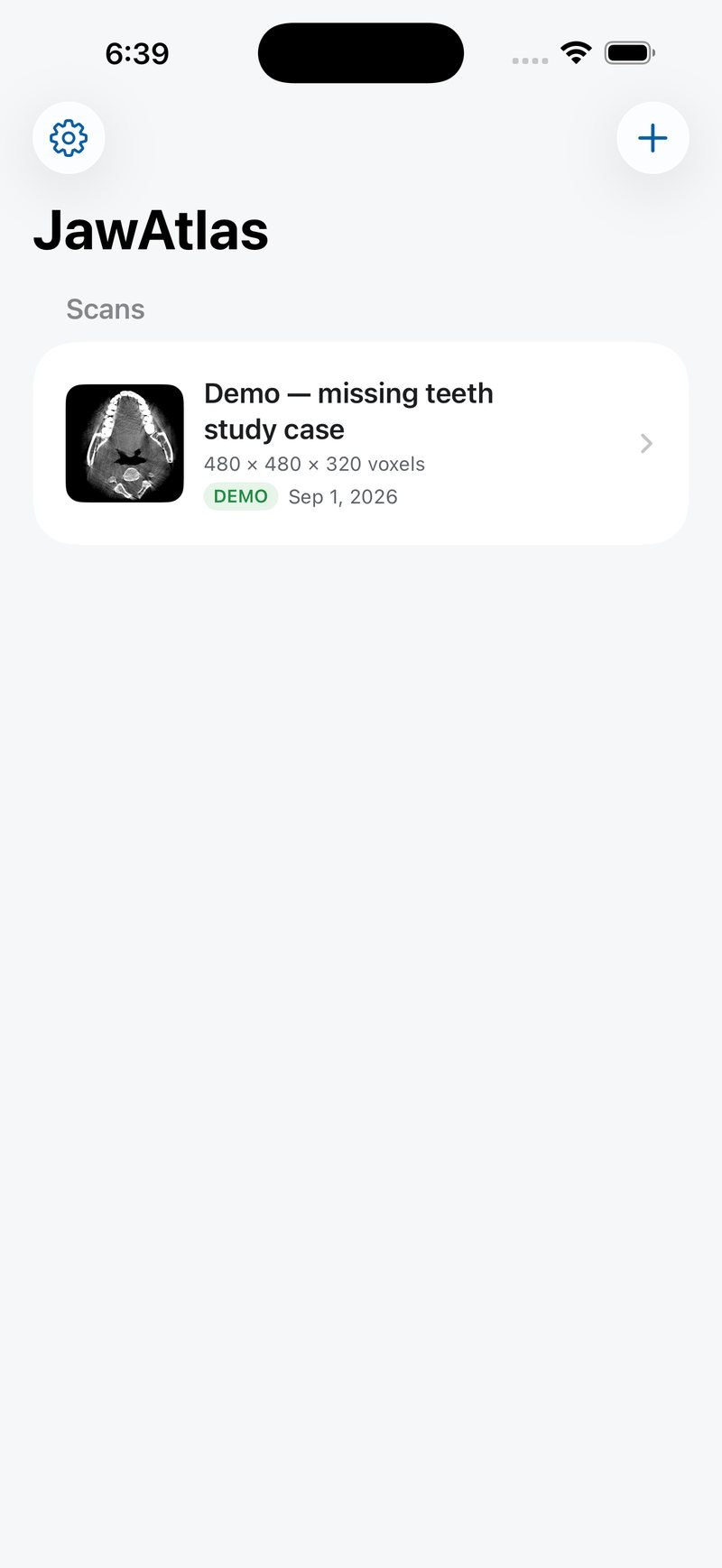
| Adults' dental CBCT images dataset for detecting and classifying missing teeth (Feng, Li, Gu, Wang and Yu, Science Data Bank) | CC BY 4.0. Direct download, no account. | Dental CBCT in DICOM from 158 adults: 85 cases with missing teeth and 3D annotations, 73 without annotations. About 23.6 GB as a ZIP, plus a DICOM to PNG script. | Real dental CBCT, DICOM, free to redistribute. The JawAtlas demo scan is case M29 from this set, so you can compare your own imports against a known volume. |
| STS-Tooth: a multi-modal dental dataset for semi-supervised segmentation (Zenodo) | CC BY 4.0. Direct download from Zenodo, split into fifteen ZIP parts. | About 31.8 GB. 3D CBCT volumes of 512 by 512 by 400 voxels, reported as 371 volumes (32 with tooth labels), published as NIfTI, plus 4,000 panoramic radiographs with 900 masks. | A large pool of CBCT volumes with tooth masks. Needs conversion from NIfTI to DICOM before JawAtlas can open it. |
| ToothFairy2 (University of Modena and Reggio Emilia, MICCAI 2024 challenge) | CC BY-SA, stated on the challenge dataset page. Free account required to download; publications must cite the challenge papers. | 480 CBCT volumes at 0.3 mm isotropic voxels, with expert segmentations of 42 classes including jaws, teeth, inferior alveolar canals, maxillary sinus and pharynx. MHA files in nnU-Net layout. | The segmentations are an answer key: load the volume, find the canal or the sinus yourself, then check against the label. Needs conversion to DICOM. |
| ToothFairy (MICCAI 2023 challenge, inferior alveolar canal) | CC BY-SA, stated on the challenge dataset page. Free account required; cite the papers. | 443 CBCT volumes as NumPy arrays: 153 with dense voxel-level canal annotations and 290 with sparse ones. The page also offers the raw DICOM data with sparse annotations. | Built around the mandibular canal, so it pairs well with the canal page on this site. The DICOM option imports into JawAtlas without conversion. |
| CTooth (Cui and colleagues) | CC BY 4.0, stated in the repository. The download link is closed; access is by email request through the repository's data requisition note. | 22 fully annotated CBCT volumes (5,803 slices, 4,243 with tooth labels) with a range of restorations, implants and appliances, plus a PyTorch segmentation library. A larger CTooth+ release adds unlabeled volumes. | Small enough to study case by case, with plenty of metal to learn artifacts from. Expect a wait for access. |
| Mandibular CT Dataset Collection (Wallner, Mischak and Egger, Medical University of Graz, figshare) | CC BY 4.0. Direct download, no account. | 10 anonymised clinical CT scans of the craniomaxillofacial region as NRRD and TIFF stacks, each with two expert mandible segmentations as masks and STL surfaces. About 1.3 GB. | Medical CT rather than CBCT, so a good side by side to see why CBCT grey values are not Hounsfield units. Needs conversion to DICOM. |
| Maxillofacial bone dataset for the MARGO project (Zenodo) | CC BY 4.0. Direct download, about 581 MB. | 115 segmented mandible surfaces as PLY meshes, 240 rendered thumbnails of CT and CBCT scans, landmark coordinates and a subject datasheet. No volumes. | Surface anatomy of the mandible for comparison with your own 3D renderings. Meshes cannot be loaded into JawAtlas. |
| Teeth3DS and Teeth3DS+ (3DTeethSeg and 3DTeethLand MICCAI challenges) | Hosted on OSF; the project website is CC BY-SA 4.0 and the data is described as freely available, but no separate data license is stated. Check the OSF pages before reuse. | About 1,800 intraoral scans from 900 patients as OBJ surface meshes with per-vertex tooth labels in FDI numbering, plus landmark annotations. | Surface meshes of crowns, not CBCT: useful for learning tooth morphology and FDI numbering, but not loadable in JawAtlas. |
| HNSCC (The Cancer Imaging Archive, MD Anderson) | Images fall under the NIH Controlled Data Access Policy and need a request through TCIA; clinical spreadsheets are CC BY 3.0 and 4.0. Not a simple open download. | 627 patients with head and neck cancer: CT, PET, MR and radiotherapy structures in DICOM, about 310 GB in total. | Full head medical CT in DICOM, for seeing the whole maxilla, sinuses and skull base at CT contrast. Only worth it if your course can handle the access request. |
| A multimodal dental dataset facilitating machine learning research and clinic services (PhysioNet) | PhysioNet Contributor Review Health Data License. Credentialed access: training, a data use agreement and review of your study by the contributor. | 329 CBCT scans from 169 patients as DICOM series (about 420 slices each), 8 panoramic radiographs and 16,203 periapical images, with metadata. | DICOM CBCT that imports directly, but the access process is designed for research projects rather than self study. |
Choosing one to start with
If you want something that works today with no conversion, download a case or two from the Science Data Bank set. It is DICOM, it is CC BY 4.0, and the JawAtlas demo scan comes from it, so you already know what the volumes look like. If you want an answer key while you learn anatomy, ToothFairy2's 42-class segmentations are the richest, at the cost of a free account and a conversion step. If your interest is specifically the inferior alveolar canal, the original ToothFairy release with its DICOM option is the direct route (see finding the mandibular canal).
Whole datasets are large. Download one or two cases rather than everything, and keep a note of the case identifier so you can cite it later.
Bringing a dataset into JawAtlas
JawAtlas imports DICOM folders and ZIP archives, and it needs at least four slices in a series. There are three routes, all offline:
- Files app. Copy the DICOM folder for one case into the JawAtlas folder in the Files app, then use Import from Files in the app. This is the route for large downloads done on a computer and copied over with a cable or iCloud Drive. Full steps: import DICOM from Files.
- ZIP by AirDrop or share sheet. Zip the case folder on a Mac, AirDrop it to the device and choose JawAtlas. The app unpacks the archive and builds the series. See import CBCT by AirDrop.
- Shared case package. If a classmate or educator has already imported a case and added moments and notes, they can share the whole case and you import it in one step. A folder of such packages can be batch-imported.
Two things to know about formats. JawAtlas reads uncompressed, deflated, RLE lossless and JPEG lossless DICOM; lossy JPEG, JPEG 2000 and JPEG-LS files are rejected per file with a message, so if a dataset was exported with lossy compression you will need to re-export it losslessly. And NIfTI, NRRD, MHA or NumPy volumes must be converted to a DICOM series on a computer first, which free desktop research viewers can do (see what is DICOM). Once a case is in, the importer strips every identifying tag, keeps only the technical ones it needs, and the scan never leaves the device (see offline and private).
Patient privacy
A CBCT scan is personal data, and a head scan can in principle be used to reconstruct a face, which is why some archives have moved their head and neck images behind an access request. Use data that is openly licensed and already anonymised by its authors, and nothing else. Every set in the table above was published by its authors for reuse; that is what makes it legal for you to download it.
Never load real patient scans from a clinic, hospital or university onto a personal device without explicit permission from the institution and proper anonymisation. The fact that JawAtlas strips identifiers on import does not make copying the data in the first place lawful; the permission has to come before the copy. If your course gives you scans to study, ask how they were anonymised and what you are allowed to do with them, and delete them when the course asks you to.
Finally, attribution. CC BY and CC BY-SA require you to credit the authors when you share anything built on their data, including slides, a case shared with classmates or a PDF summary exported from JawAtlas. Put the dataset name and DOI in the case notes when you import, and the credit travels with the case (see sharing a case and exporting a PDF).
Questions students ask
Where can I download a free CBCT scan to practise on?
Start with the Science Data Bank dataset by Feng and colleagues, which is CC BY 4.0 and in DICOM, and with the STS-Tooth release on Zenodo, also CC BY 4.0. The ToothFairy datasets are CC BY-SA and need a free account. The table on this page lists each one with its license and format.
Which datasets can JawAtlas open directly?
JawAtlas imports DICOM folders and ZIP archives of DICOM files. Datasets published as NIfTI, NRRD, MHA or NumPy arrays need converting to DICOM on a computer first, and surface mesh datasets such as Teeth3DS are not volumes at all and cannot be loaded.
Can I load scans from my clinic or university onto my phone to study?
Not without permission. Real patient scans are personal data wherever they are stored, and copying them to a personal device usually needs approval from the institution and proper anonymisation. Use openly licensed datasets for self study instead.
Do I need to cite a dataset if I only use it for learning?
A CC BY license requires attribution whenever you share or publish something that uses the data, including slides and teaching material. For private study nobody checks, but getting into the habit of citing the source is good practice and costs nothing.
JawAtlas is an education and training aid. It is not a medical device and must not be used for diagnosis, treatment planning or any clinical decision.
Last reviewed 2026-10-13