 JawAtlas
The demo scan
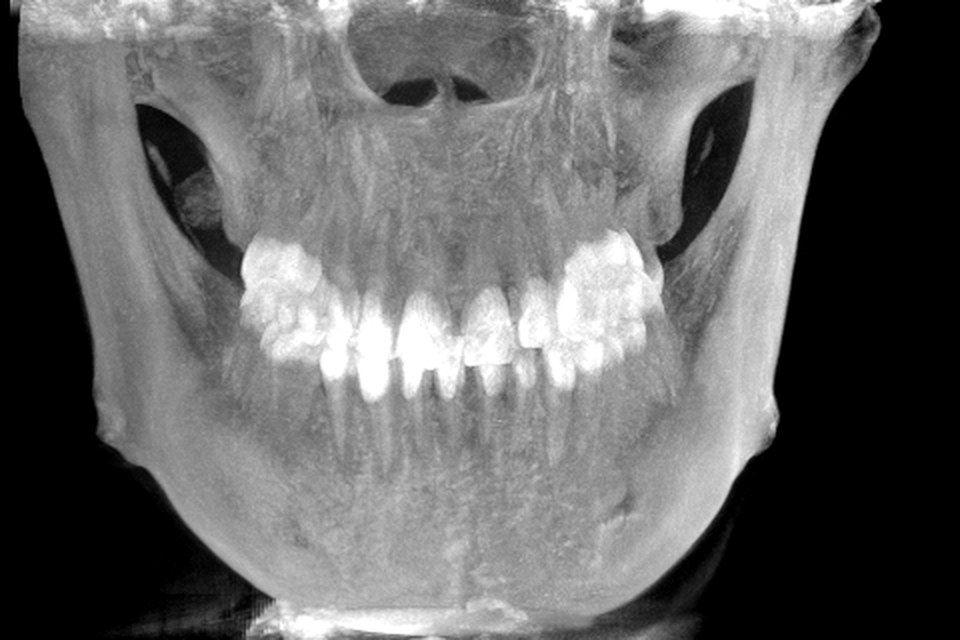
A real adult mandible CBCT, openly licensed and already anonymised, ships inside the app so there is something worth studying from the first launch.
Source and license
The scan is case M29 from "Adults' dental cone beam computed tomography images dataset for detecting and classifying missing teeth" by Lan Feng, Zhi Li, Qihang Gu, Yaqi Wang and Xiaoyang Yu, published on Science Data Bank, doi.org/10.57760/sciencedb.26465, and used under the CC BY 4.0 license. The credit also appears in the app's Settings.
What it contains
| Volume | 480 x 480 x 320 voxels |
|---|---|
| Voxel size | 0.266 x 0.266 x 0.252 mm |
| Field of view | About 127 x 127 x 80 mm, a large-FOV mandible |
| Anatomy | Full arch, both rami, a left posterior edentulous site, a clearly traceable inferior alveolar canal, the floor of the maxillary sinuses at the top of the field |
| Transfer syntax | Explicit VR Little Endian, uncompressed 16-bit |
How it is used
On first launch the app runs the bundled DICOM series through the same import path as any scan you add yourself, which also proves that path on every device. The Demo case can be restored from Settings if you delete it. A default arch is traced so the Pano stage works immediately.
Learning with it
The guides on this site use the demo scan for every example: following the mandibular canal, field of view and voxel size, and the reading routine. When you want more cases, see free CBCT datasets.